Sep 1, 2026LED Product Knowledge
COB vs SMD LED Strip Lights: Which Should You Choose?
Comparing COB vs SMD LED strip lights? Learn the key differences in brightness, color uniformity, heat dissipation, cost, and best applications to make the right choice.
COB vs SMD LED Strip Lights: How to Choose for Your Project
When sourcing LED strip lights for commercial or residential projects, one of the most critical decisions you'll face is choosing between COB vs SMD LED strip technology. Both technologies dominate the global LED strip market, but they serve different purposes and excel in different applications. Understanding the difference between COB and SMD LED strip lights — from chip structure and optical performance to cost and installation — will help you make an informed purchasing decision that meets your project's technical requirements and budget constraints.
Whether you're a distributor building your product catalog, a contractor specifying lighting for a large-scale project, or a lighting brand developing a private-label line, this comparison covers the key considerations. Full disclosure: HST Light manufactures both COB and SMD LED strips, so we have a direct interest in this technology. The specifications below are factual and can be checked against any reputable manufacturer's data sheet.
What Is SMD LED Strip Light?
SMD stands for Surface Mounted Device. SMD LED strips use individual LED chips mounted directly onto a flexible printed circuit board (PCB). Each SMD LED package contains one or more diodes (typically 1, 2, or 3), and the chips are spaced at regular intervals along the strip — commonly 60, 120, or 240 LEDs per meter.
Key Characteristics of SMD LED Strips
- Chip types: SMD2835, SMD5050, SMD3528, SMD3014, and SMD5630 are the most common
- LED density: Ranges from 30 LEDs/m to 240 LEDs/m depending on the model
- Beam angle: Typically 120°
- Luminous efficacy: 80–120 lm/W for quality SMD strips
- CRI options: 80+ (standard), 90+ (high CRI), 95+ (premium)
- Voltage options: 5V, 12V, 24V, and 48V DC
SMD technology is the most widely used LED strip format worldwide. It's proven, cost-effective, and available in an enormous range of specifications. The HST Light SMD LED strip product line covers everything from standard 2835 single-color strips to high-density 5050 RGBW configurations.
What Is COB LED Strip Light?
COB stands for Chip on Board. COB LED strips use multiple bare LED chips mounted directly onto the PCB and then covered with a continuous phosphor layer, creating a single, seamless line of light. Unlike SMD strips where you can see individual LED dots, COB strips produce a smooth, dot-free illumination.
Key Characteristics of COB LED Strips
- Chip density: 180 to 1080 chips per meter (significantly higher than SMD)
- Appearance: Continuous, uniform light line with no visible LED dots
- Beam angle: Up to 180°
- Luminous efficacy: 90–130 lm/W
- CRI options: 80+, 90+, and 95+
- Voltage options: 12V, 24V, and 48V DC
- Color consistency: Excellent — the phosphor coating ensures uniform color temperature along the entire strip
COB technology has rapidly gained popularity in architectural and decorative lighting where visual comfort and uniform appearance are critical. For projects demanding premium aesthetics, explore our COB LED strip offerings at HST Light.
COB LED Strip vs SMD: Head-to-Head Comparison
To help you quickly understand the difference between COB and SMD LED strip lights, here's a detailed comparison across the key decision factors:
Feature | SMD LED Strip | COB LED Strip |
|---|---|---|
Light appearance | Visible individual LED dots | Seamless, dot-free line of light |
Chip density | 30–240 LEDs/m | 180–1080 chips/m |
Color uniformity | Good (may show slight variances between LEDs) | Excellent (phosphor layer ensures uniform color) |
Brightness | Moderate to high | High to very high |
Luminous efficacy | 80–120 lm/W | 90–130 lm/W |
Beam angle | 120° | Up to 180° |
Heat dissipation | Moderate (heat concentrated at each LED) | Better distributed (heat spread across the entire PCB) |
Flexibility | More flexible (fewer components per segment) | Slightly less flexible (dense chip mounting) |
Cutting interval | Typically 25mm–50mm (varies by model) | Typically 12.5mm–25mm (finer cutting intervals) |
Cost | Lower | 15–40% higher than equivalent SMD |
Availability | Widely available, many suppliers | Fewer manufacturers, limited but growing |
Best for | General lighting, cove lighting, backlighting | Architectural lighting, display cases, premium residential |
Key Differences Explained in Detail
1. Light Quality and Visual Appearance
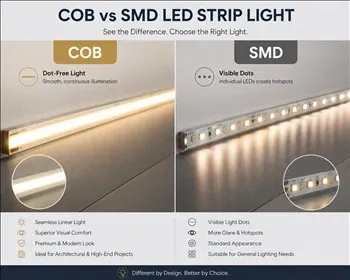
The most immediately noticeable difference when comparing COB LED strip vs SMD is the light output appearance. SMD strips produce distinct points of light — each LED is visible as an individual dot. At lower densities (60 LEDs/m), these dots are quite pronounced, which can be undesirable in applications where the strip is directly visible or installed close to a diffusing surface.
COB strips, on the other hand, produce a continuous, uniform line of light with zero visible dots. This is achieved through the high chip density (often 500+ chips per meter) combined with the phosphor coating that blends the light output into a single smooth line. The result is a premium, polished look that's particularly valued in architectural lighting, retail display lighting, and high-end residential applications.
2. Brightness and Luminous Efficacy
Both technologies can achieve high brightness levels, but COB strips generally deliver higher luminous flux per meter due to the sheer number of chips packed into each meter. In our lab measurements, a premium COB strip at 528 chips/m outputs 1,500–2,000+ lumens per meter, while a high-density SMD strip at 240 LEDs/m typically outputs 1,200–1,800 lumens per meter.
In terms of luminous efficacy (lumens per watt), COB technology has a slight edge — typically 90–130 lm/W compared to SMD's 80–120 lm/W. This is because the COB packaging reduces thermal resistance and allows for more efficient light extraction. For energy-conscious projects, this efficiency advantage can translate into measurable operating cost savings over time.
3. Color Consistency and CRI
Color consistency is where COB technology truly shines. The continuous phosphor layer applied across all chips ensures that the correlated color temperature (CCT) remains uniform along the entire length of the strip. SMD strips can sometimes show slight color variations between individual LEDs — a phenomenon known as "color mixing" — which becomes more noticeable in direct-view applications.
Both technologies support high CRI options. For commercial and retail applications where color rendering is critical, HST Light offers both SMD and COB strips with CRI 90+ and CRI 95+ options, achieving R9 values of 50+ for accurate red rendering.
4. Heat Dissipation and Lifespan
Heat management is crucial for LED strip longevity. COB strips distribute heat more evenly across the entire PCB surface because the chips are mounted continuously rather than concentrated at discrete points. This distributed thermal load generally results in lower junction temperatures and can contribute to longer LED lifespan.
However, COB strips generate more total heat per meter due to the higher chip count, so proper thermal management — using aluminum channels or heat sinks — is essential, especially for high-power COB strips running at 15W/m or above. SMD strips, with their lower density and individual chip spacing, are somewhat more forgiving in this regard but still benefit from proper heat sinking for maximum lifespan.
Both quality COB and SMD strips from reputable manufacturers should deliver 50,000+ hours of rated lifespan under proper operating conditions.
5. Flexibility and Installation
SMD strips are generally more flexible and easier to bend around tight corners because the components are spaced out. COB strips, with their dense chip packing, are slightly stiffer — though modern manufacturing techniques have significantly improved COB strip flexibility.
COB strips offer finer cutting intervals (as small as 12.5mm), which is advantageous when you need precise lengths for custom installations. SMD strips typically have cutting intervals of 25–50mm, which may result in slightly wasted material when fitting specific lengths.
Both types use standard 3M adhesive backing for surface mounting and are compatible with aluminum profiles, connectors, and dimming controllers. If your installation involves moisture, bathrooms, or outdoor exposure, match the right waterproofing level with our LED strip IP ratings guide.
6. Cost Comparison
SMD LED strips are more cost-effective to manufacture due to the mature production process, high component availability, and economies of scale. COB strips carry a price premium of approximately 15–40% over equivalent SMD strips, reflecting the more complex manufacturing process and higher chip count.
For large-volume projects, this cost difference can be significant. However, the premium appearance and superior light quality of COB strips can often command higher retail prices, making them attractive for distributors and brands targeting the mid-to-high-end market segment.
If you're evaluating cost vs. performance for a specific project, contact HST Light for a detailed quotation comparing both technologies across your required specifications.
Which Applications Are Best Suited for Each Technology?
Choose SMD LED Strip Lights When:
- Budget is a primary concern: SMD offers the best lumens-per-dollar for general lighting
- Indirect lighting applications: Cove lighting, under-cabinet lighting, and backlighting where the strip is hidden
- RGB and color-changing applications: SMD5050 RGB and RGBW strips offer mature, reliable color mixing
- High-volume projects: Widely available with shorter lead times and lower MOQs
- Retrofits and replacements: SMD strips match the form factor of most existing LED strip installations
Choose COB LED Strip Lights When:
- Direct-view applications: The seamless light line eliminates hot spots and visible LED dots
- Architectural and decorative lighting: Premium aesthetics for hotels, restaurants, retail spaces
- Display case and showcase lighting: Uniform illumination without distracting LED points
- Narrow profile installations: COB strips work exceptionally well in slim aluminum channels
- Color-critical applications: Superior color consistency along the entire strip length
- Projects requiring premium positioning: Higher perceived value supports premium pricing
Making the Right Choice for Your Project
When deciding between COB vs SMD LED strip lights, consider these key questions:
- Will the strip be directly visible? If yes, COB is usually the better choice for its dot-free appearance.
- What's your target price point? For budget-sensitive projects, SMD provides excellent value.
- Do you need RGB or color-changing capability? SMD technology currently offers more mature multi-color options.
- What's the required brightness level? Both can deliver high output, but COB edges ahead at maximum lumen density.
- Are there thermal constraints? Consider the total wattage per meter and ensure adequate heat sinking for either type.
For distributors and brands, offering both technologies in your product range allows you to address different market segments — value-oriented customers with SMD and premium-focused customers with COB. HST Light's OEM/ODM services support custom specifications for both technologies, including custom PCB widths, CCT options, CRI levels, and private-label packaging.
A Note on Our Experience
HST Light is a Shenzhen-based LED strip manufacturer with 15 years of production experience across both COB and SMD technologies, operating a 3,000㎡ factory with automated SMT lines and full aging-test facilities. Our certifications — CE, RoHS, UL, and ETL — are verified and current. We offer free samples for qualification testing, and our MOQ starts from 500m for custom specifications. You're welcome to evaluate our products alongside any other supplier on the same criteria covered in this guide.
Conclusion
The COB vs SMD LED strip comparison doesn't have a universal winner — the right choice depends entirely on your project requirements, target market, and budget. SMD LED strips offer proven performance, wide availability, and excellent value, making them ideal for general lighting and large-volume applications. COB LED strips deliver superior visual quality, better color uniformity, and a premium aesthetic that justifies their higher cost in architectural, retail, and high-end residential applications.
By understanding the technical differences outlined in this guide, you can make a confident, informed decision that aligns with your project's needs and your customers' expectations.
Ready to discuss your LED strip project? Contact HST Light today for free consultation, samples, and competitive pricing on both COB and SMD LED strips.