

Flexible LED sheets for light boxes can distribute light across wide backlit surfaces, including retail graphics, illuminated signs and shallow display panels. But the best result depends on more than LED count or watts. The sheet, diffuser, enclosure depth, power supply and installation method work as one optical and electrical system.
This B2B selection guide explains how to specify a backlighting project, compare samples and reduce the risk of hotspots, dark edges, color differences or difficult maintenance before bulk purchasing.
HST Light Flexible LED Sheet Reference Models
Our flexible LED sheet range includes single-color, dual CCT, RGB and RGBW options. All seven reference models operate at DC24V. The table below summarizes the sheet-level specifications for the current HST Light range; final configuration and project suitability should be confirmed before ordering.
| Model | Lighting Type / LED Package | LEDs per Sheet | Sheet Size | Power |
|---|---|---|---|---|
| HST2835X288 | Single Color / SMD2835 | 288 | 480 × 240 mm | 22W |
| HST2835X420 | Single Color / SMD2835 | 420 | 500 × 250 mm | 44W |
| HST2835TW576 | Dual CCT / SMD2835 | 576 (288WW + 288CW) | 480 × 240 mm | 11W + 11W |
| HST2835TW840 | Dual CCT / SMD2835 | 840 (420WW + 420CW) | 500 × 250 mm | 22W + 22W |
| HST5050RGB162 | RGB / SMD5050 | 162 | 480 × 240 mm | 18W |
| HST5050RGBW162 | RGBW (4-in-1) / SMD5050 | 162 | 480 × 240 mm | 24W |
| HST5050RGBW800 | RGBW / SMD5050 RGBW | 800 | 500 × 250 mm | 48W |
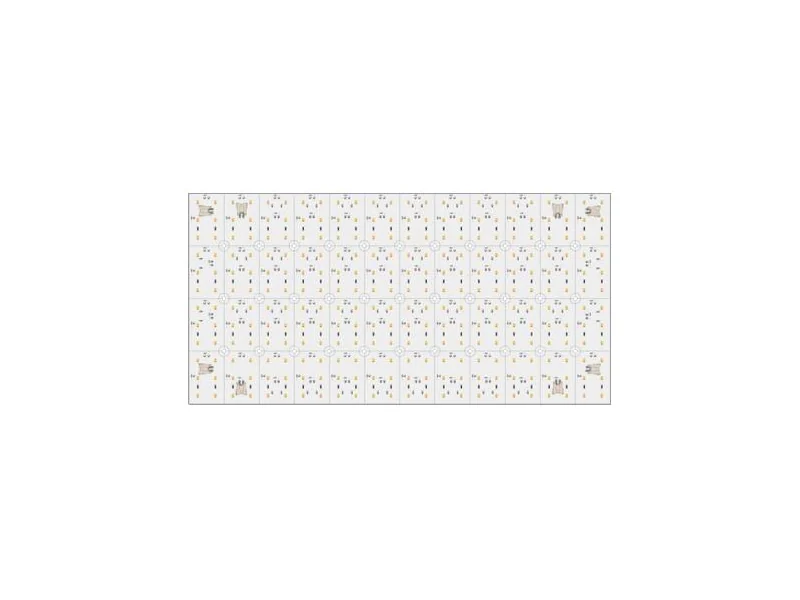
HST2835X288 single-color flexible LED sheet — representative reference product.
The reference quotation lists 2700K, 3000K, 4000K and 6500K white-light options, selected red/green/blue/yellow configurations, and CRI options above 80, 90 or 95 depending on the selected model. OEM and ODM configurations are available for technical review. The listed mounting methods are 3M-9495-300LSE tape or screws, with model-specific sheet-to-sheet connectors.
How to Choose Between Single-Color, Dual CCT, RGB and RGBW
Single-Color Backlighting
HST2835X288 (22W/sheet) and HST2835X420 (44W/sheet) are reference options for fixed-color illuminated signage, light boxes and wide backlit panels. Compare actual illuminance, required sheet count and operating temperature in the intended enclosure rather than selecting solely by the number of LEDs.
Adjustable White Light (Dual CCT)
HST2835TW576 has 576 SMD2835 LEDs arranged as 288 warm-white + 288 cool-white emitters, with 11W + 11W listed power per sheet. HST2835TW840 has 420WW + 420CW emitters and 22W + 22W listed power. Both use the reference DC24V architecture; confirm the compatible dual-CCT controller and available CCT mixing range for the actual configuration.
Color-Changing RGB and RGBW Backlighting
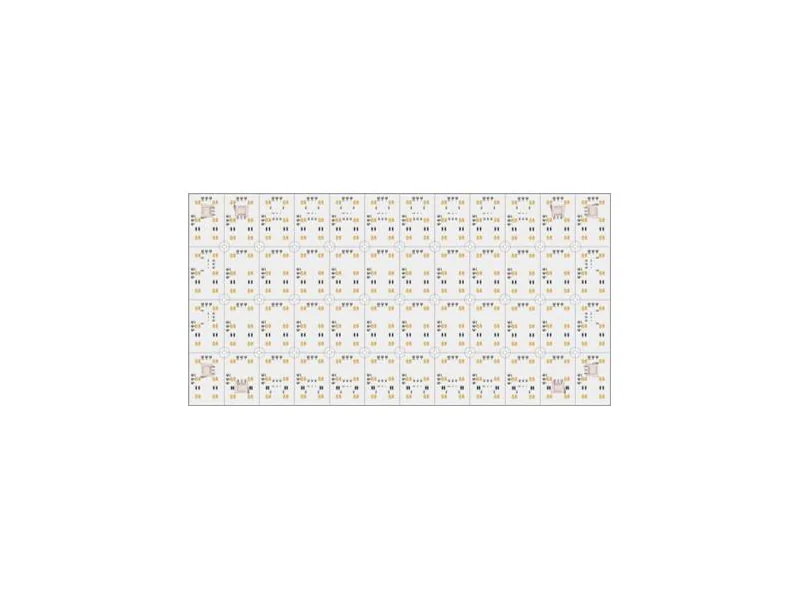
The HST5050RGB162 RGB model is rated at 18W/sheet. RGBW reference options are HST5050RGBW162 (24W/sheet) and HST5050RGBW800 (48W/sheet, SMD5050 RGBW). Confirm channel allocation, controller output and wiring before approval. The illustrated RGB/RGBW reference photograph in the supplied quotation is reused for the two 162-LED entries, so it should not be treated as two distinct model-specific photographs.
Installation and Shallow Light Boxes
The HST reference sheet describes cutting along appropriate locations, bending to suit flat or curved surfaces, modular quick connectors and an example of a light-box cavity as shallow as 4 cm. These are application options, not universal guarantees: approved cut locations, maximum connected sheet quantity, bending limits and minimum usable depth depend on the actual electrical and optical assembly.
1. Start with the light-box dimensions and diffuser
Record the illuminated width and height, available cavity depth, diffuser material and thickness, internal reflectivity, graphics or cladding, expected viewing distance and access for service. A shallow cavity gives light less room to mix and can make LED pitch and diffuser performance more critical.
Ask whether the lighting surface uses printed fabric, acrylic, translucent stone or another finish. A material that looks uniform with one sample can reveal bright points or dark bands with another. Test the actual diffuser or a representative substitute—not only an uncovered LED sheet on a workbench.
2. Compare LED pitch and light uniformity
LED density tells you how many emitters are used; LED pitch describes the distance between emitters. A closer pitch can help at short mixing distances, but does not guarantee a dot-free panel. Lens construction, cavity depth, reflection, diffuser transmission and operating power also matter.
For meaningful comparisons, request a layout drawing and illuminate a mock-up with the intended diffuser. Check brightness near the center, corners, cutouts and joints, as well as the appearance at normal viewing distance. If the project uses multiple neighboring panels, also compare the color and brightness consistency between panels.
3. Select voltage, driver and wiring as a system
Confirm the exact candidate sheet’s rated voltage, operating power and permissible connection arrangement. Calculate the total load for the full illuminated area rather than assuming that one driver can power any number of connected sections. The driver must be correctly rated for the load, installation and control requirements.
Large layouts may require parallel distribution, additional feed points or separate control zones. Agree on the wiring diagram, connector method and protection arrangement before ordering. When dimming is required, test the actual driver, dimmer and sheet together, including low-output behavior, flicker-sensitive applications and visual uniformity.
4. Confirm cutting patterns, connection points and mounting
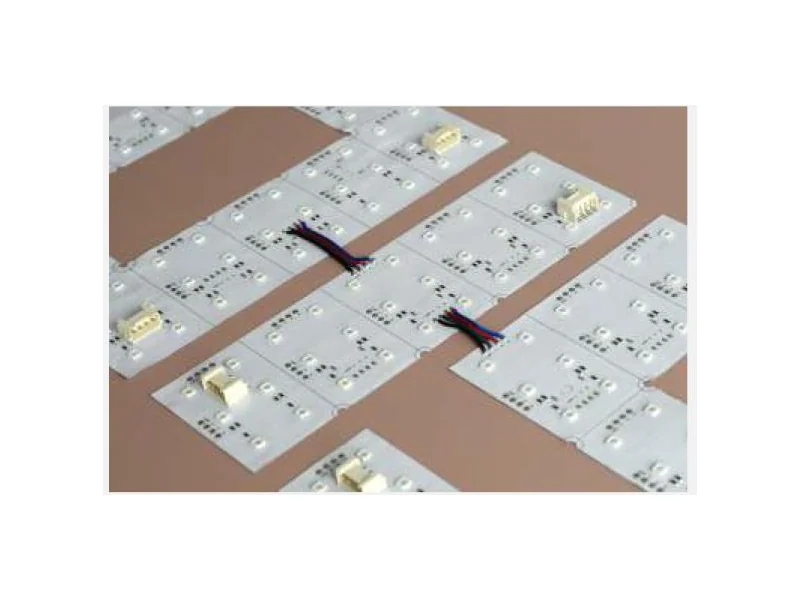
Not every flexible LED sheet is cuttable in every direction or at every point. Request the manufacturer’s approved cutting layout, allowable bend conditions, terminal positions and connection instructions. If the installation includes holes, unusual panel shapes or mounting hardware, verify that the remaining circuit and connection points are still valid after any approved cuts.
Check the mounting surface and method, whether adhesive or mechanical fixing is planned, and whether connections remain accessible for replacement. The substrate and installation materials also affect thermal management. A “flexible” product is not automatically suitable for tight folds, repeated bending or unventilated enclosures.
5. Ask for model-specific optical and electrical evidence
For a professional quotation, compare documents and samples from the exact model and configuration being offered. Useful evidence may include:
- Rated voltage, power and recommended electrical connection method.
- Layout drawing, LED spacing and approved cutting pattern.
- Color temperature (CCT), tolerances and any relevant CRI or R9 requirement.
- Measured light output, test conditions and the method used to assess uniformity.
- Recommended diffuser arrangement or tested light-box depth, if available.
- Thermal observations and information on the intended mounting surface.
- Applicable protection or compliance documentation for the exact configuration, where required.
A generic report for another LED strip, driver or unfinished sheet is not proof that a custom assembled panel meets the same requirements. Ask which model, batch, operating conditions and finished construction the evidence actually covers.
6. Plan for thermal conditions and maintenance
LED sheets generate heat. Evaluate the enclosure temperature, mounting substrate, contact surfaces, ventilation and any heat-trapping graphics or back panels. Measure conditions after the mock-up reaches a stable operating temperature. Pay attention to the middle of wide panels, wiring junctions and areas with less airflow.
In damp or wash-down environments, review the entire installed structure—including seams, cable entries, cuts and connectors—before specifying an ingress-protection requirement. An IP-rated component or coating does not by itself prove the final assembled construction has the same rating.
Ask how individual sections will be serviced and whether approved replacement sections are interchangeable in color and brightness. Keep records of the final drawing and approved sample for repeat production.
7. Approve a representative mock-up before placing a volume order
A small, realistic light-box mock-up often reveals problems that are invisible in a standalone product photo. Build it with the specified diffuser, cavity depth, mounting surface, wiring and driver, then record:
- Center-to-edge uniformity and visible LED points or joints.
- Color consistency between sheets or adjacent panels.
- Measured input voltage, current and power.
- Operating temperature after stabilization.
- Dimming behavior, where applicable.
- Cutting, connection and installation practicality.
- Any environmental testing required for the finished assembly.
Compare the results against documented acceptance criteria. Keep the approved sample and note any later material, layout or component revision that would require revalidation. For more on this process, see HST Light’s guide to validating custom LED samples before production.
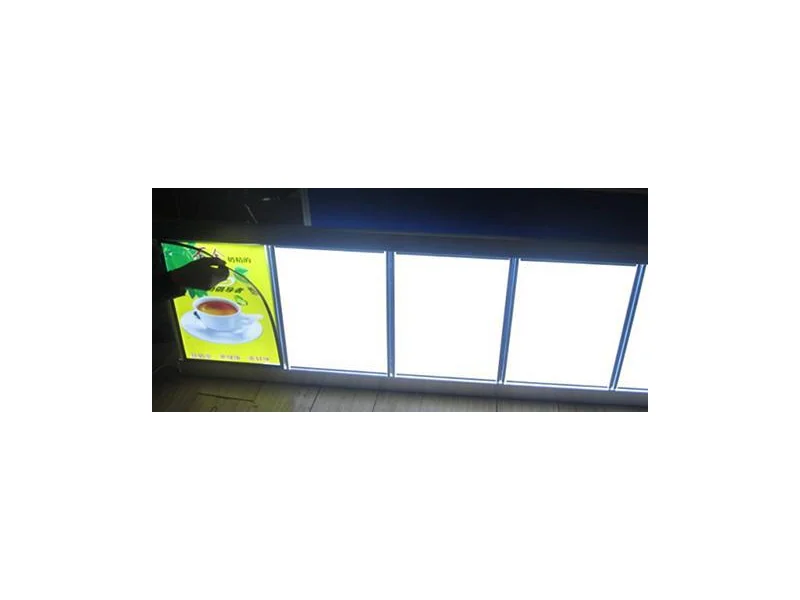
Illustrative light-box application image from the HST reference quotation; not presented as a verified HST customer installation.
Flexible LED sheets vs LED strips: which suits a backlit panel?
A sheet-style layout is worth evaluating when the design needs light spread over a broad area. Linear LED strips may be a better fit where the design is based on rows, edges, profiles or separately positioned light lines. Neither approach is universally more efficient or more uniform: compare the actual light-box assembly, including optical mixing, wiring, thermal conditions and installation cost.
If your project is based on conventional strips, our LED Strip Buyer’s Guide explains the main electrical and optical specification choices. For project-specific design reviews, see our OEM/ODM engineering process.
What to include in a flexible LED sheet RFQ
Send the panel’s width, height and depth; diffuser or illuminated material; color and brightness target; required operating voltage; dimming or control method; approximate panel quantity; indoor or outdoor exposure; cutting requirements; and any drawings or photos. State the application and testing expectations rather than relying only on a requested LED density.
HST Light can review your project requirements and discuss suitable backlighting approaches or custom LED lighting alternatives, subject to confirmed technical feasibility and product availability. Specific models, sample availability, measured performance and compliance details should be confirmed before quotation.
Request a project review and quotation or contact HST Light with your panel drawings and target specifications.
Frequently asked questions
Can flexible LED sheets be cut into any shape?
No universal cutting rule applies. Follow the exact product’s approved cutting pattern and connection instructions, and confirm the electrical design after any permitted cuts.
How much depth do I need between an LED sheet and the diffuser?
There is no single depth that works for every combination. LED pitch, optics, diffuser transmission, cavity reflectivity and the desired appearance all affect the result. Use a realistic mock-up to establish an acceptable distance.
Does a higher LED density always give better backlighting?
No. Higher density does not independently guarantee more usable light, better efficiency or perfect uniformity. Compare the finished panels at the relevant electrical and optical test conditions.
Can one LED driver power several flexible LED sheets?
Only if the combined electrical load, voltage architecture, wiring and protection scheme are compatible with the selected driver. A qualified designer should confirm the installation.
Do flexible LED sheets require thermal management?
Yes. The appropriate mounting and heat-transfer arrangement depends on the sheet’s power, construction and enclosure. Confirm temperature under representative operating conditions.
Can a custom cut-and-connected LED sheet be rated IP65 or IP67?
Any claimed rating needs appropriate support for the final assembled configuration, including connections, cuts, seals and cable exits. Do not assume that an unmodified component’s rating extends to a customized installation.