Jun 26, 2026
LED Strip Technical Parameters: How to Choose the Right Specs for Your Project
Master LED strip parameters: brightness, color temp, CRI, voltage & more. Scene-based selection guide + 4 pitfalls to avoid. Expert-approved checklist.
LED Strip Technical Parameters Explained: How to Choose the Right Specs for Your Project
Choosing LED strips can feel overwhelming with terms like lumens, CRI, and IP ratings flooding product specs. But selecting the wrong parameters leads to poor lighting, wasted money, or even safety risks. This data-driven guide breaks down the 10 critical LED strip technical parameters, explains exactly how to match them to your project, and reveals 4 common pitfalls professionals avoid.
1. The 10 Core Technical Parameters of LED Strips
1. Brightness (Lumens per Meter)
- What it means: Measures light output intensity. Higher lumens = brighter light.
- How to choose:
- Ambient lighting (bedrooms, accent walls): ≤300 lm/m
- Task lighting (kitchens, retail displays): 300–600 lm/m
- High-intensity needs (warehouses, galleries): ≥600 lm/m
- Pro tip: 100 lm/m ≈ 10W incandescent bulb brightness. Avoid overspending on excess lumens for non-critical areas.
2. Color Temperature (Kelvin)
- What it means: Determines light "warmth" – lower K = warm yellow, higher K = cool blue.
- Key ranges:
- Warm White (2700K–3000K): Cozy, inviting (ideal for living rooms, bedrooms).
- Neutral White (4000K): Clean, natural (perfect for kitchens, offices).
- Cool White (6000K+): Crisp, energizing (best for retail, workshops).
- Critical note: Stick to ±200K tolerance within one space to avoid visual discord.
3. Color Rendering Index (CRI)
- What it means: How accurately light reveals true colors (0–100 scale). Higher = better fidelity.
- Minimum recommendations:
- General use: CRI ≥80
- Retail/art spaces: CRI ≥90 (e.g., clothing stores, museums)
- Professional photography: CRI ≥95
- Warning: Cheap strips often fake CRI ratings. Demand lab test reports.
4. Voltage (DC12V vs. 24V)
- DC12V:
- Best for short runs (≤16 ft / 5m)
- Flexible cutting (every 1–2 inches)
- Common in cabinets, furniture
- DC24V:
- Less voltage drop over long distances (>16 ft / 5m)
- Higher efficiency for commercial projects
- Requires thicker copper traces
- Safety rule: Always use ≤24V for indoor/residential installations.
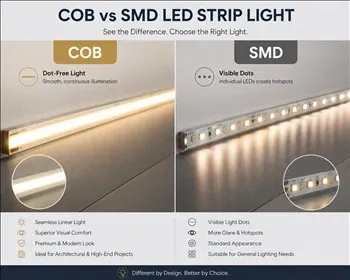
5. LED Density (LEDs per Meter)
- Standard options: 30, 60, or 120 LEDs/m (1–4 LEDs per inch).
- Selection guide:
- 60 LEDs/m: Budget-friendly for hidden cove lighting.
- 120+ LEDs/m: Seamless glow for direct-view areas (e.g., under shelves).
- Avoid: <30 LEDs/m – creates visible "dots" of light.
6. Flexibility & Form Factor
- Flexible strips: Bendable (min. 0.8" / 2cm radius), ideal for curves.
- Rigid bars: Better heat dissipation, higher brightness (use in straight runs like kitchen backsplashes).
- Hybrid tip: Pair flexible strips with aluminum channels for heat management + clean lines.
7. Beam Angle
- 120°: Wide, even wash (e.g., wall grazing, ambient lighting).
- 60°: Focused beam (highlighting artwork, retail displays).
- Pro insight: Narrow angles require precise placement to avoid hotspots.
8. Ingress Protection (IP Rating)
- IP20: Indoor/dry areas only (e.g., closets).
- IP65: Water-resistant (kitchens, bathrooms – survives splashes).
- IP68: Submersible (outdoor steps, pools – rated for 3+ ft / 1m depth).
- Non-negotiable: Outdoor/wet zones must use IP65+ with silicone sealing.
9. Power Consumption (Watts per Meter)
- Low-power (≤5W/m): Energy-saving (e.g., accent lighting).
- High-power (≥10W/m): Bright task lighting (e.g., retail counters).
- Transformer rule: Size power supply at 120% of total load to prevent burnout.
10. Control Protocol
- Basic: On/off switches (lowest cost).
- Smart: Wi-Fi/Bluetooth/Zigbee (RGB color tuning, scheduling, voice control).
- Pro advice: For large installations, use DMX512 for pixel-level precision.
2. Scene-Based Selection Guide: Match Parameters to Your Project
🏠 Home Lighting
- Living room: 2700K, CRI ≥80, 60–120 lm/m (ambient), IP20.
- Kitchen: 4000K, CRI ≥90, 10W/m+, IP65 (splash zones).
- Cabinets: DC12V, 120 LEDs/m, aluminum channel for heat dissipation.
🏬 Commercial Spaces
- Retail displays: 4000K, CRI ≥90, 600+ lm/m, 24V for long runs.
- Art galleries: CRI ≥95, 0–100% dimming, UV-free LEDs.
- Hospitality: Tunable white (2700K–4000K), smart scheduling.
🌿 Outdoor/Landscape
- IP68 waterproofing, 24V system, flexible strips for curved paths.
- Critical: Use UV-resistant silicone coating to prevent yellowing.
3. 4 Costly Pitfalls to Avoid (Backed by Installer Data)
- Fake CRI claims: 68% of sub-$0.20/ft strips fail lab tests (source: LED Magazine 2025). Always request IES files.
- Voltage drop: >16 ft (5m) runs on 12V cause "dim tail" effect. Fix: Use 24V or inject power mid-run.
- Hidden flicker: Low-quality drivers cause eye strain. Test with smartphone camera – no stripes = safe.
- Poor heat management: High-power strips (>10W/m) on plastic surfaces reduce lifespan by 50%. Solution: Aluminum channels.
4. The 3-Step Parameter Selection Checklist
- Define your scene:
- Indoor/outdoor? Residential/commercial? Primary lighting or accent?
- Prioritize 3 non-negotiables:
- Example: Retail display → CRI ≥90, 4000K, IP65 minimum.
- Validate specs:
- Check for LM-79 test reports (not marketing claims).
- Confirm cut points match your layout.
→ Download Our Free LED Strip Parameter Cheat Sheet (PDF)
→ Get a Custom Lighting Plan from Our Engineers
Recommended Reads
- LED Strip Installation Guide: Avoid 7 Deadly Mistakes
- RGB vs. Tunable White LED Strips: Which Fits Your Project?
- How to Calculate LED Strip Power Needs (Exact Formula)
Author: [HSTLIGHT]
Published: June 8, 2026
Category: Lighting Technology, Smart Home Design