
LED Strip Underwater: IP68 Pools, Fountains and What Fails First
LED strip underwater: only IP68 strips can go under water, IP65 and IP67 cannot — what fails first in pools and fountains, and what to check before ordering.

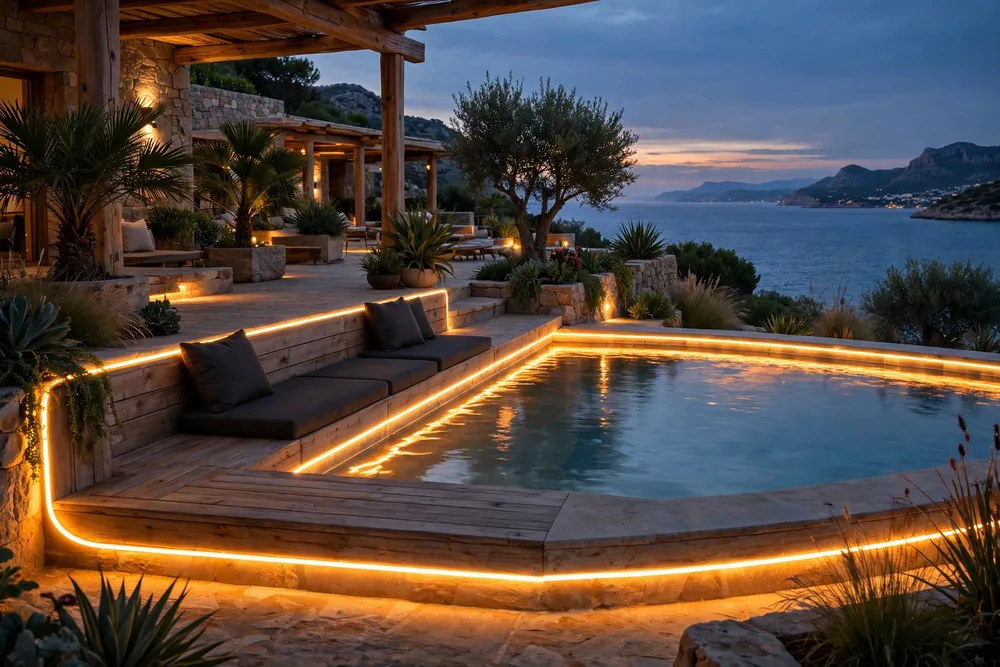
Can a LED strip underwater survive in a pool or a fountain? The short answer is yes — but only if it is IP68, and only if the whole installation is built for water, not just the strip. An IP65 strip will fail. An IP67 strip will fail more slowly. And an IP68 strip with an unsealed end cap will fail just as surely as either of them.
This guide explains what “underwater” actually means for a LED strip underwater, what fails first in pools and fountains, and what to check before ordering — with our pool strip as the example.
What “Underwater” Actually Means: IP68, and Only IP68
The IP rating is the Ingress Protection code defined by IEC 60529: two digits, the first for solid objects, the second for water. For a LED strip underwater, only the second digit matters, and only one value qualifies:
| Rating | Water protection | Underwater? |
|---|---|---|
| IP20 | None | No |
| IP44 | Splashing | No |
| IP65 | Low-pressure water jets | No — jets are not immersion |
| IP67 | Immersion up to 1 m for 30 minutes | No — temporary immersion only |
| IP68 | Continuous immersion, manufacturer-specified | Yes — the only underwater rating |
IP65 is a common misunderstanding when buyers choose a LED strip underwater. It is dust-tight and protected against low-pressure water jets, which makes it a good outdoor strip — but a jet is not immersion, and a strip that survives rain will not survive a pool. IP67 is closer: it survives immersion up to 1 metre for 30 minutes, which covers a flooded deck or a splash zone. But 30 minutes is not a season, and “temporary immersion” is not a pool. Only IP68 is rated for continuous immersion.
There is one more caveat, and it matters. IP68 does not by itself confirm suitability for every pool, fountain, aquarium, or marine installation. The rating describes protection under the immersion conditions specified for the tested product — the permitted depth and duration, the water chemistry, the electrical safety of the complete assembly, including cable entries and terminations. An IP68 LED strip underwater in a shallow fountain is not automatically right for a deep pool. For the full rating system, see our guide to LED strip light IP ratings.
What Fails First in Pools and Fountains
When a LED strip underwater fails, the strip itself is rarely the first thing to go. The failure is almost always at a joint, an end, or a connection. Five failure points, in the order we see them:
1. The end caps. A strip is a sealed extrusion with two open ends, and the ends are sealed by caps. If a cap is missing, loose, or badly glued, water enters at the end and travels along the strip. This is the single most common failure in pool installations, and it is also the most preventable: every cut end must be capped and sealed, and the seal must be checked before the strip goes in the water.
2. The connectors and cable entries. Every place a wire enters the strip is a place water can enter. A connector that is fine in the rain can leak on a LED strip underwater, because immersion puts water pressure on the seal continuously. The rating applies to the complete assembled system, not to the strip alone — a waterproof strip with an ordinary connector is not a waterproof installation. Cable entries need the same treatment: sealed, strain-relieved, and above the waterline wherever the design allows.
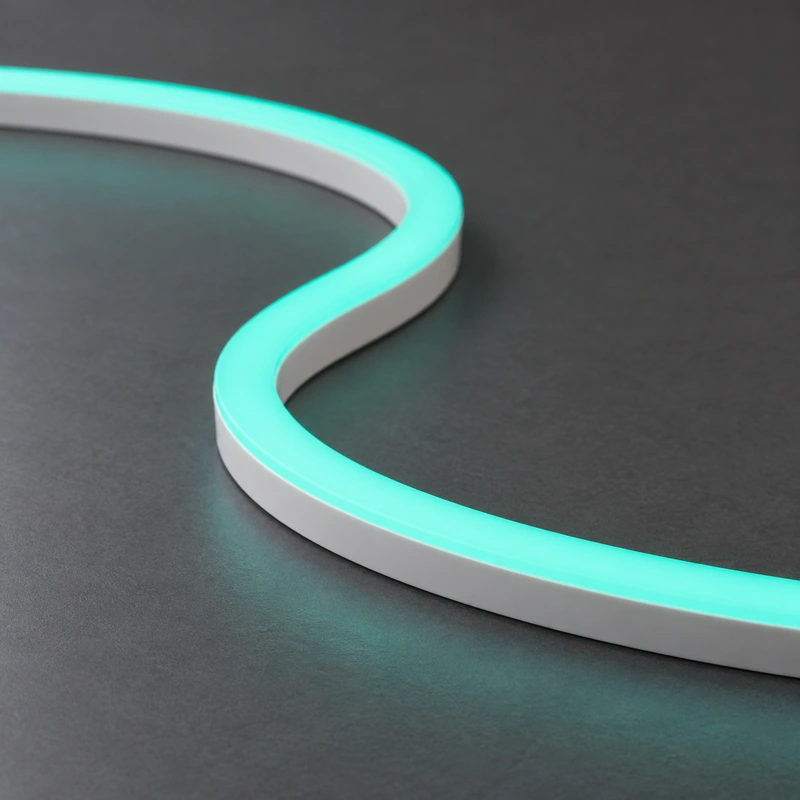
3. The adhesive. Most strips are mounted with adhesive tape, and adhesive fails underwater. Water creeps under the tape, the strip peels, and the loose strip flexes — which stresses the seals at the ends. For a LED strip underwater, the mounting must be mechanical: a channel, a clip, or a profile that holds the strip in place without relying on glue. Our waterproof LED strip range is built for this kind of mounting, and the 10mm IP68 LED neon flex is a sealed silicone tube that sits in a channel rather than sticking to a surface.
4. Physical damage to the sleeve. A silicone sleeve protects the strip, but it is not armour. A sharp edge on a pool coping, a cleaning tool, or a footstep can nick the sleeve, and a nick is a leak path. Inspect the sleeve before installation and protect it where it passes over edges.
5. The driver in the water. The IP68 rating on a LED strip underwater covers the strip, not the driver. The power supply must stay dry — mounted above the waterline, in a dry enclosure, with the cable run sealed where it enters the water. A driver that goes underwater is an electrical safety failure, not a warranty claim.
The Pool and Fountain Checklist
Before ordering a LED strip underwater for a pool or fountain, run through this checklist. It is the difference between a strip that lasts and a strip that comes back in a bag.
- Depth and duration, per model. Ask for the permitted immersion depth and duration for the exact model. “IP68” alone does not state them — they are set by the manufacturer for the tested product, and they vary.
- Water chemistry. Pool water is chlorinated, fountain water may be treated, and salt water is harsher still. Ask whether the strip and its seals are compatible with the water it will sit in. Environmental compatibility is part of the IP68 caveat, not an afterthought.
- The complete assembly. For a LED strip underwater, the rating covers the strip, the caps, the connectors, and the cable entries together. Ask how the assembly is sealed, and whether the connectors supplied with the strip are rated for immersion or only for rain.
- Cut and reseal. If the strip will be cut to length, ask for the approved cutting and sealing procedure for that model, and follow it exactly. Cutting or re-terminating an IP-rated strip affects the protection of the finished assembly — the rating describes the tested product, not a modified one. Silicone sealant and end caps are part of the procedure, not optional extras.
- The driver location. Confirm the driver stays dry and accessible, with the cable sealed where it enters the water.
- A test before the full install. Run one section of the LED strip underwater at the real depth for a day before installing the whole run. A leak in a test section costs a strip; a leak in a finished pool costs the job.
Our 3D swimming pool LED strip is specified at IP68 for pool use. The rating is confirmed; the permitted depth, duration, and water chemistry for a specific pool are confirmed per project, not assumed from the rating alone.
What to Ask Before Ordering
A LED strip underwater is a specification, not a single number. Before ordering, ask for four things:
- The IP68 conditions for the exact model. Permitted depth, permitted duration, and the water it was tested in.
- The termination procedure. How the ends are capped and sealed, which connectors are supplied, and whether they are immersion-rated.
- The mounting method. A channel or clip system, not adhesive tape, for anything that will sit underwater.
- A sample. Test it at the real depth, in the real water, before the full order. A strip that survives a day underwater at the project depth has earned the order; a datasheet line has not.
If a supplier cannot answer those four questions for the exact model, the strip is not ready for your pool — whatever the IP rating on the box says.
Frequently Asked Questions
Can IP67 LED strips go underwater?
No, not for continuous use. IP67 is rated for temporary immersion — up to 1 metre for 30 minutes — which covers a flooded deck or a splash zone, not a pool. A LED strip underwater in a pool or fountain needs IP68, the only rating for continuous immersion.
What IP rating do I need for a swimming pool?
IP68. But for a LED strip underwater, the rating alone is not enough: verify the permitted immersion depth and duration for the exact model, the water chemistry it was tested in, and the sealing of the complete assembly, including cable entries and terminations. Our pool strip is specified at IP68, and the depth and duration for a specific pool are confirmed per project.
Can I cut an IP68 strip and keep it waterproof?
Only if the cut end is resealed properly. Cutting or re-terminating an IP-rated strip affects the protection of the finished assembly, so follow the approved cutting and sealing procedure for that model — end caps and silicone sealant are part of it. A LED strip underwater with an unsealed cut end will fail at the cut.
Why did my waterproof strip fail underwater?
Check the failure points in order: an unsealed end cap, a connector or cable entry that leaked, adhesive that let go, a nick in the sleeve, or a driver that got wet. Most underwater failures are at a joint or an end, not in the strip itself — and a strip rated IP65 or IP67 was never suitable for continuous immersion in the first place.
Talk to Us
A LED strip underwater is one of those jobs where the specification matters more than the price. Tell us the pool or fountain: the depth, the water, the length of the run, and whether the strip will be cut to size. We will confirm the IP68 conditions for the model, the termination procedure, and the mounting — and a sample tested at the real depth will settle the rest. Browse our waterproof LED strip range or contact us with your project details.