
LED Strip Duv: Why Colour Temperature Alone Is Not Enough
LED strip Duv: why two strips at the same colour temperature can look green or pink, what the Duv number means, and what to ask before ordering.

Two LED strips sit side by side on the same white wall. Both boxes say 4000K. One looks clean and neutral; the other looks faintly green. Both strips really are 4000K. The difference is a number the box does not print. That number is LED strip Duv, and it is why two strips at the same colour temperature can look like two different whites.
This guide is for the buyer choosing a strip for rooms where white has to look right — the retail wall, the hotel corridor, the studio, the kitchen. It covers what LED strip Duv is, why colour temperature cannot see tint, what the numbers mean, where tint comes from, and what to ask before ordering.
What LED Strip Duv Measures
LED strip Duv is the second number that describes a white. Colour temperature tells you where it sits along the warm-to-cool line; LED strip Duv tells you how far it sits off that line — toward green on one side, toward magenta on the other.
The line has a name: the Planckian locus, the curve of colours a heated black body passes through as it gets hotter. A white exactly on the curve has a Duv of zero. Above the curve, a positive Duv reads green or yellow-green; below it, a negative Duv reads magenta or pink. LED strip Duv is that signed distance, measured in the CIE 1960 colour space — the only number on a datasheet that answers “green or pink?”
A strip can be honestly labelled 4000K and still look green, because 4000K never promised a position on the curve — only a position along it. The kelvin figure is one dimension; LED strip Duv is the other one.
Why Colour Temperature Cannot See Tint
Colour temperature is a projection, not a location. To assign one, you draw a perpendicular line from the light’s colour point to the Planckian locus and read off the temperature where it lands. Two points on opposite sides of the curve can project to the same temperature — they share a CCT and sit on opposite sides of white.
Picture the acceptable zone for one colour temperature as an ellipse. The long axis runs along the Planckian locus: a shift along it is a warmer or cooler white. The short axis runs across the locus: that is the LED strip Duv direction, and a shift along it is a greener or pinker white. CCT measures position along the long axis; LED strip Duv measures position along the short one. A datasheet that prints only the kelvin figure has described the long axis and said nothing about the short one.
A low CRI figure does not explain a green cast, and a high CRI figure does not rule one out. Colour rendering scores measure how faithfully colours are shown; LED strip Duv measures where the white itself sits. A strip can render colours well and still sit off the locus. Our tunable white CRI guide explains the rendering side; this guide covers the tint side.
What the Numbers Mean
The Duv scale is small, and that is the point: tiny numbers are visible. The table follows the usual industry guidance, per ANSI C78.377 binning and IES TM-30 white-point characterisation.
| LED strip Duv | What you see | How to treat it |
|---|---|---|
| 0.000 | On the locus, neutral white | Reference |
| +0.003 | Faint green tint | Premium spec limit |
| +0.006 | Visible green | Reject for premium work |
| +0.010 | Strong green | Reject |
| −0.003 | Faint pink, often preferred | Premium spec limit |
| −0.006 | Visible pink | Acceptable in interiors only |
| −0.010 | Strong pink | Reject |
ANSI and EnergyStar recommend Duv between −0.006 and +0.006; for more demanding work, −0.003 to +0.003 is preferred. A premium specification is often written as three numbers, not one: the colour temperature, the Duv limit, and the binning tolerance — for example, 4000K, Duv within ±0.003, 3-step MacAdam.
To feel the size of these numbers: in one published test, a 95 CRI 5000K LED was measured three times with a handheld spectrometer — about 5075K, Duv average −0.0011. Colour-correction gels were placed in front of the sensor: plus-green gels raised the Duv, minus-green gels lowered it, almost perfectly linear.
The test’s rule of thumb: one-eighth plus or minus green gel equals about 0.004 of Duv — so a strip whose Duv range runs beyond ±0.004 varies more than a one-eighth green gel correction. The test warned this is an approximation from a single 5000K sample. Take it as a sense of scale, not a conversion formula.
One asymmetry deserves attention. A faint pink cast is often liked — it reads as warm and inviting, and some premium hospitality fixtures deliberately specify a Duv around −0.002 at 3000K. A green cast is almost never liked: it reads as sickly or fluorescent, and it is the tint people notice first on a white wall and on skin. LED strip Duv is not a symmetric problem — the green side costs more than the pink side.
Where Tint Comes From
Tint starts in the phosphor. A white LED is a blue chip coated with yellow and red phosphor, and the mix decides where the white lands: lean green and LED strip Duv goes positive; lean red and it goes negative. Reputable chip makers hold the mix tight; generic chips drift.
The second reason is binning. LED chips are sorted into tolerance zones called MacAdam ellipses, measured in steps (SDCM); a 3-step ellipse is a premium tolerance. But an ellipse describes tolerance, not direction: two chips inside the same 3-step ellipse can sit on opposite ends of it and look different side by side. Binning decides whether an installation looks unified or patchy; LED strip Duv decides which way each chip leans.
The third reason matters most for tunable white strips. A tunable white strip makes its intermediate whites by mixing its warm and cool channels, and the mixed white does not sit on the Planckian locus — it sits on the straight line between the two channel colours, and a straight line between two points on a curve always runs below the curve.
The mix drifts magenta as it tunes, and most consumer tunable strips push positive Duv at the high colour-temperature end instead. Premium fixtures hold Duv along a defined locus as they tune. If you are buying a tunable white COB strip, ask about LED strip Duv at the colour temperatures you will actually use, not only at the ends of the range.
The fourth reason is the camera. A slight tint the eye forgives reads as full-on green or pink on a phone camera, and retail photographers reject fixtures that look fine in person. For work that will be photographed, the safe limit is tighter than the eye needs — around |Duv| 0.002.
How to Check LED Strip Duv Before Ordering
Four checks cover the choice before the order. First, the Duv range itself: what is it, on the datasheet, for the exact model and colour temperature you plan to order? Ask for it the way you would ask for the CRI — as a number with a range, not a single value. A datasheet that prints only the kelvin figure has not answered the tint question at all. LED strip Duv is a number to ask for, not a number to assume.
Second, the binning tolerance next to it: how many MacAdam steps, and is the batch single-lot binned so the whole run matches? A 3-step tolerance is the premium figure; a wider tolerance with an unchecked Duv is how an installation ends up measled — one length green, the next pink.
Third, the spectrum or the TM-30 report behind the numbers. If the supplier publishes the spectrum, look at where the white sits, not only at the CRI. If not, ask for the photometric report. A cheap lux meter cannot measure LED strip Duv at all — it reads brightness, not colour position. A handheld spectroradiometer gives CCT, Duv, CRI and TM-30 in one reading.
Fourth, test with a sample on a white wall. Run the sample strip at the brightness and colour the room will use, against a plain white surface, and look at the wall — not at the strip. A green cast shows first on white, before it shows on skin. That is the test that decides the order. LED strip Duv is checked on paper first and on a wall second, and a supplier who cannot produce the figure is telling you something.
One distinction is worth making before you order. A green cast on a face can come from two causes: a white point sitting above the locus — positive LED strip Duv — or a spectrum missing red, the R9 problem our R9 guide covers. The fix is different in each case, so check both numbers: Duv for where the white sits, R9 for whether the red is there. A strip can fail either check while passing the other.
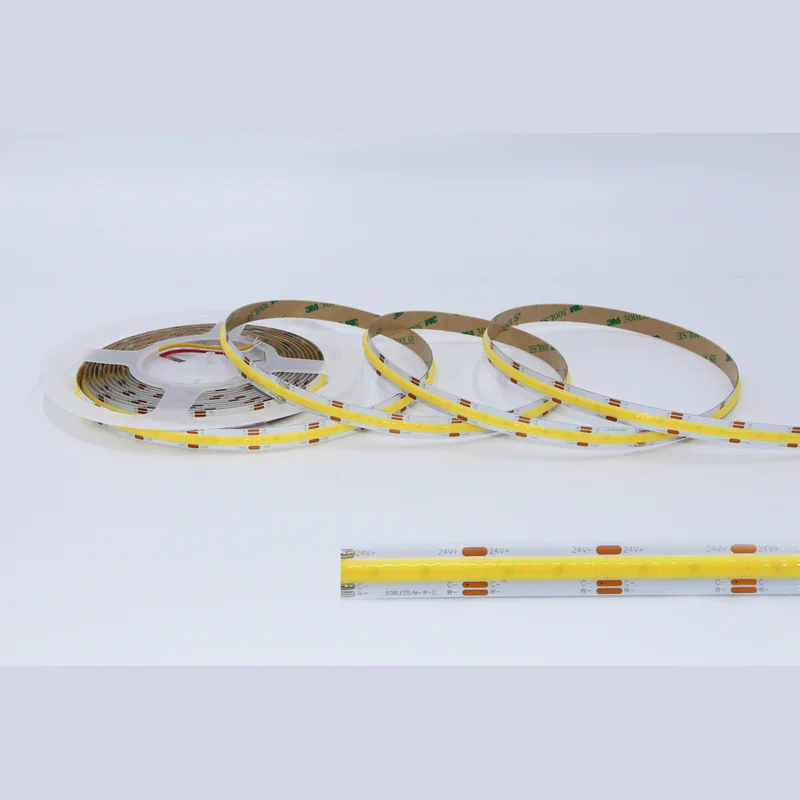
Our own position, honestly stated: we publish no Duv figures yet, so LED strip Duv is To Be Confirmed per model — ask for it on the datasheet, and if the data does not support the number you need, we will say so. Our free-cut COB strip runs at Ra above 90, and our museum strip targets CRI 97 or above with near-zero ultraviolet below 400 nm — a design target, to be confirmed per project. LED strip Duv is bought on evidence, and the evidence should come before the order.
Frequently Asked Questions
What is a good Duv value for an LED strip?
As a general guide, ANSI and EnergyStar recommend Duv between −0.006 and +0.006, and for more demanding work −0.003 to +0.003 is preferred. A premium specification is often written as three numbers: the colour temperature, the Duv limit, and the binning tolerance. LED strip Duv is a number to ask for on the datasheet, next to the CRI figure, not to guess from the kelvin figure alone.
Why do two strips at the same colour temperature look different?
Because colour temperature is one dimension. Two whites can share a CCT and sit on opposite sides of the Planckian locus — one green, one pink — and LED strip Duv is the number that tells them apart. The same applies inside one installation: two chips in the same 3-step binning ellipse can sit on opposite ends of it. Ask for the Duv range and the binning steps, and test a sample on a white wall.
Can I fix a green tint after installing?
Only partly. A minus-green gel or filter can pull a green white back toward neutral — one published test puts one-eighth minus green at about 0.004 of Duv — but a filter can only take light away, it cannot add the wavelengths the strip never emitted, and it costs brightness. Specify LED strip Duv before the order, not after the install.
How do I measure Duv?
With a handheld spectroradiometer, which reports CCT, Duv, CRI and TM-30 in one reading. A lux meter cannot measure it, and a phone camera cannot be trusted for it — cameras amplify tint shifts. If you do not own a spectrometer, ask the supplier for the Duv range and the photometric report for the exact model and colour temperature, then confirm it with a sample on a white wall.
Talk to Us
Choosing a strip for a room where white has to look right — a retail wall, a hotel corridor, a studio, a kitchen? Tell us the room, the colour temperature and the brightness, and we will help you match the strip, the driver and the controller, and confirm the Duv figure per model. LED strip Duv is a question to settle before the order, not after the install — request a quote or see our free-cut COB strip. For background, see the colour temperature overview.