
Tunable White LED Strips: How to Specify CRI (Ra, R9 and TM-30)

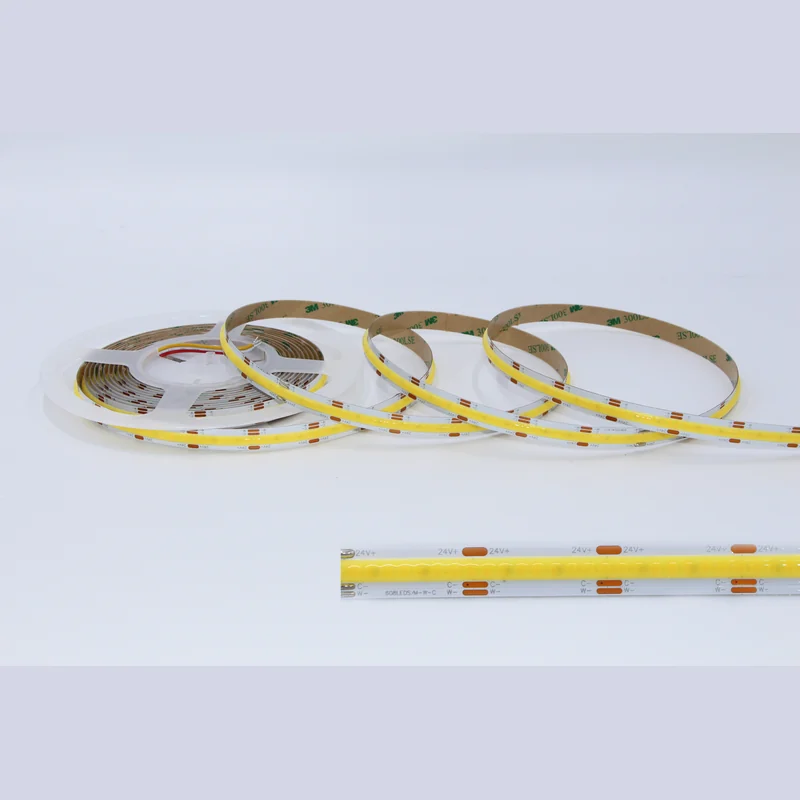

Tunable White LED Strips: Why CRI Deserves More Attention
On a fixed-white strip, colour rendering is a single question: how faithfully does this one CCT reproduce colours compared with a reference light? Tunable white LED strips answer that question at least three times — at the warm setting, at the cool setting, and at the blends in between, where two LED channels mix. The channels rarely perform identically, so tunable white LED strips can render beautifully at 3000K and noticeably worse mid-blend. For retail, hospitality and residential projects, where the light is judged by how it treats skin, food, timber and merchandise, specifying CRI properly means looking past the single headline number.
Ra: The Average That Hides the Problem
The familiar CRI figure, Ra, is an average of eight test colours (R1–R8) — all of them relatively muted, pastel samples. Averaging hides weaknesses: a strip can score Ra 90 while rendering one important colour family badly, as long as the other seven compensate.
The practical reading of Ra is still useful as a first filter. Ra 80 is a common baseline for general commercial spaces; Ra 90 and above is the usual expectation where colour is part of the product — clothing, cosmetics, food, galleries, premium interiors. But on tunable white LED strips, always ask at which CCT the Ra was measured. A datasheet figure quoted only at the best-performing setting tells you little about the rest of the range. Request values at both endpoint CCTs and at a mid-blend.
R9: The Number That Decides Reds
The standard Ra average deliberately excludes the saturated test colours, including R9 — a deep, saturated red. That exclusion matters because red is where cheap phosphor recipes save money, and because so much of what people judge depends on it: skin tones, fresh food, red meat, wood finishes, brick, brand colours and printed packaging.
R9 can be low, zero, or even negative while Ra still prints a respectable number on the box. This is the single most common reason a “high CRI” installation disappoints in person. When you specify tunable white LED strips, add an explicit R9 minimum next to the Ra target. For colour-critical retail and hospitality work, R9 of 50 or higher is a common specification requirement; treat it as a separate line item, measured at each CCT setting you will actually use.
TM-30: The Fuller Picture
IES TM-30 was developed to fix the known blind spots of the Ra method. Instead of eight pastel samples, its fidelity index Rf is calculated from 99 colour samples drawn from real-world objects, which makes the score harder to game and more representative of mixed interiors. Rf values land in a similar range to Ra, so an Rf of 90-plus carries roughly the meaning buyers expect — with better evidence behind it.
TM-30 also reports Rg, the gamut index. Rg near 100 means colours appear about as saturated as under the reference light; above 100 they are enriched, below 100 they are dulled. Neither direction is automatically wrong — a slight enrichment can flatter merchandise, while a fidelity-driven gallery brief may want Rg close to 100 — but you can only choose if the data is reported. For a colour-critical tunable white LED strips project, asking for a TM-30 report alongside Ra and R9 is a reasonable, increasingly standard request.
How to Specify CRI on a Tunable White Strip
| Check | What to specify or request | Why |
|---|---|---|
| Ra per setting | Ra at warm endpoint, mid-blend and cool endpoint | Performance varies across the tuning range |
| R9 minimum | An explicit R9 floor (e.g. ≥50 for premium retail/hospitality) at each setting | Ra excludes saturated red entirely |
| TM-30 data | Rf and Rg report, if available, for colour-critical projects | 99-sample fidelity plus saturation behaviour |
| Test report | Integrating-sphere / photometric report behind the figures | Datasheet numbers should trace to a measurement |
| Colour consistency | CCT tolerance / binning information for repeat orders | Keeps later batches matched to approved samples |
| Sample approval | A production sample checked under your own finishes and merchandise | CRI is ultimately judged on your materials, not the datasheet |
Colour rendering is measured on the colour rendering index scale; see the overview for how Ra and R9 are defined for tunable white LED strips.
Specifying Tunable White at HST Light
Our currently published tunable white LED strips product is the 10mm Dual-Color COB LED Neon Flex (model HST-NF10-22W-Ra90): a 608 LEDs/m COB neon flex with 3000K and 6000K white-light options, specified at Ra 90, in an IP67 format for architectural, commercial and furniture lighting. As its product page states, CCT and CRI can be customised on this platform, and OEM projects are evaluated case by case. If your project carries specific Ra, R9 or TM-30 targets, send them with your CCT range and application details; samples are typically ready in 3–5 days, so the rendering can be verified on your own materials before a bulk order.
Frequently Asked Questions
Is Ra90 enough for retail and hospitality lighting?
Ra90 is a good starting point, but on its own it does not guarantee that reds, skin tones and merchandise will render well, because Ra excludes the saturated red sample R9. For colour-critical spaces using tunable white LED strips, specify a minimum R9 alongside Ra.
What is a good R9 value for tunable white LED strips?
R9 is not part of the Ra average, so it has to be asked for separately. Values above 0 are the bare minimum; specifiers on premium retail and hospitality projects commonly require R9 of 50 or more. Treat any “high CRI” claim without an R9 figure as incomplete.
What is the difference between CRI Ra and TM-30 Rf?
Ra averages eight pastel test colours. TM-30’s fidelity index Rf uses 99 colour samples drawn from real objects, so it is harder to optimise for and gives a more representative score. TM-30 also reports Rg, a gamut index that shows whether colours will look more or less saturated than the reference.
Conclusion
On tunable white, “CRI 90” is the beginning of the specification, not the end of it. Ask for Ra at each CCT setting on tunable white LED strips, set an explicit R9 floor so reds are covered, and request TM-30 Rf/Rg data when the project is colour-critical — then confirm with a sample under your own finishes. Browse our tunable white LED strips and neon flex range, or contact us with your CCT and CRI targets and we will help you evaluate a suitable configuration.